Why do a “text message biography”? Part 2

May 26 2020

I wanted to tell Jesus’ story in a way that creates connections, even collisions, with people’s experiences today.

Thinking beyond the book, some other concept-options on the table were a timed virtual tour (like on museum Web sites), a Twitter feed, and sending text messages.

I had already written a program to send text messages, so by the summer 2009, I started getting excited about writing a story using text-message events taking place in real-time.

After more research, I wrote text messages for the week before Easter 2010. And I asked, Would this text message idea create the collisions of experience that I envisioned?

“I am struck by the fact that Jesus is not in a hurry.”

My mom said that after receiving the messages during the 2010 beta test week. If you know the story, you know that Jesus dies on Friday. My mom was struck by Jesus’ calm because she had been recently diagnosed with cancer.

The collision of experience was instinctive. It was almost expected given the medium.

The real-time texts increased the tensions of the ordinary (the little things we deal with day to day).

The format slowed down the story and increased suspense. The question was not how the story ended, but what Jesus experienced along the way.

Join us at www.spendayearwithjesus.com.
No responses yet

Scheduling Jesus: Spring Feast Season

May 21 2020

Did Jesus keep the Law of Moses? Answering yes means feast attendance in Jerusalem.

Jesus stated emphatically, Do not think that I come to put an end to the Law or the Prophets; I have not come to abort them but to fulfill them (Mt 5:18).

He goes on to clarify that whoever dismisses even the least of the commands is held responsible, while the one who practices and teaches the commands will be identified prominently in God’s Kingdom (5:19).

In addition to Jesus’ own witness, references to the feasts in the Gospels of Luke and John point to attendance (Lk 2:41; Jn 5:1, 7:8-10).

The two spring feasts included Passover and Unleavened Bread after the barley harvest and the Feast of Weeks (or Pentecost) 50 days later after the wheat harvest.

The Law of Moses first mentions the feast attendance requirement in Exodus 23:14-17; 34:18, 22-23 and repeats the requirement in Leviticus 23 and in Deuteronomy 16.

The trip from Capernaum to Jerusalem was around 5 days, and the feasts generally lasted 8 days. (After digging into the Feast Weeks, however, I am not sure how long it lasted.) So the time investment was around 10 days of travel and around 8 days in the city.

Under normal circumstances, then, the feast attendance obligation per year required 54 days or almost two months.


No responses yet

Why do a “text message biography”? Part 1

May 19 2020

Back in 2008, I started with a traditional approach. A daily journal-book. My goal, provide information about Jesus’ humanity. How he lived. What Jesus could be doing day-by-day.

I started writing around some of the biblical stories including events like Rosh Hashanah, Yom Kippur, the Feast of Huts (aka the Feast of Tabernacles) and places like the Temple Mount and Bethany (John 7–10).

I wrote tentatively. After all, we can’t know exactly what Jesus was doing.  The tone went something like this: “Today, Jesus could have been walking along, and he met a blind man…”

After writing 50 days, I gave the 50-page manuscript to my mom and father-in-law. As you can imagine, the tentative approach was disatisfying. And more importantly it took too long to explain the “could have’s.”

So we went back to drawing board.

I wanted people to share in Jesus’ day-by-day experience. My father-in-law understood the purpose when he said, “I thought you were going to tell me about Jesus.” With renewed resolve, I continued to envision how to make those daily connections.

Join us at www.spendayearwithjesus.com. Sign up and “experience Jesus”.
No responses yet

Feast Travel Routes

May 14 2020

Have you driven cross-country maybe for a wedding or a family reunion? After everyone gathers and the small talk begins to fade, eventually the conversation resurges as weary travelers discuss the pros-and-cons of various road routes – longer interstates and shorter two-lanes, construction, traffic density, and scenery.

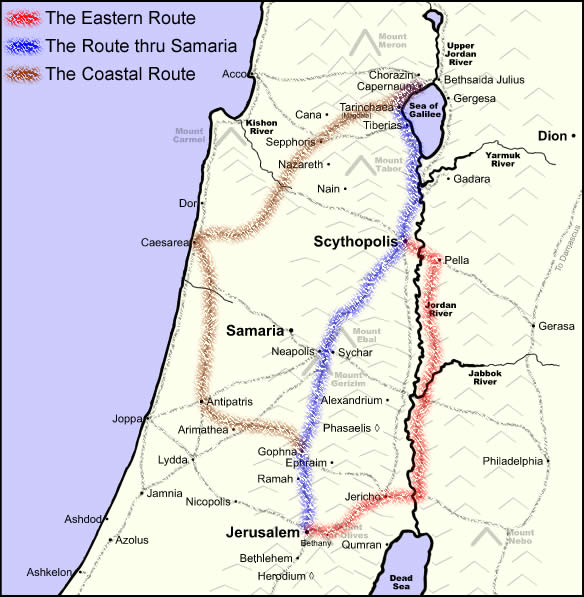
Three times a year, Jesus’ community made the trip to Jerusalem for the spring feasts and the fall feasts. There were 3 routes to Jerusalem from Galilee:

  • the western coast road Via Maris,
  • the central highland road through the Samaritan hill country,
  • and the eastern Jordan River Valley road through Perea (also known as the Transjordan).

The coast road was out of the way from Jesus’ starting and ending points. From central Galilee, the most direct route was the road through Samaria.

Ancient historian Josephus makes the following generalization, “It was the custom of the Galileans, when they came to the holy city at the festivals, to take their journeys through the country of the Samaritans” (Antiquities 20.118).

Starting from Capernaum, it makes sense for Jesus to take the third route through the Jordan valley — walking along the sea of Galilee, taking the eastern road along the Jordan River, then from Jericho up into the hills to Jerusalem.**

Jesus went through Jericho on his final journey to Jerusalem (Mk 10:46).

Shortest route appears to be the consensus among students of Jesus’ story. The Jordan Valley route is a compelling alternative. Jesus’ experience includes both routes (Mk 10:46; Lk 9:52; Jn 4:4).

** see also: D. A. Carson, The Gospel According to John (Grand Rapids: Wm. B. Eerdmans, 1991), 215; and Andreas J. Köstenberger, John in Baker Exegetical Commentary Series (Grand Rapids: Baker Academic, 2004), 146.

Three Routes to Jerusalem from Galilee

Three Routes to Jerusalem from Galilee

No responses yet

Working-Community

May 12 2020

The Gospel of John, 2005

The Gospel of John, 2005

Jesus grew up a carpenter, Joseph’s son (Lk 4:22; Mk 6:3). 2nd century churchman Justin Martyr wrote that Jesus “was considered to be the son of Joseph” and that he “was in the habit of working as a carpenter when among men, making plows and yokes…”* According to Luke’s Gospel, when he was about 30 years old, he began his teaching and healing tours (Lk 3:23). The question follows, did Jesus give up his carpenter’s apron?

The Gospel of John, 2005

The Gospel of John, 2005

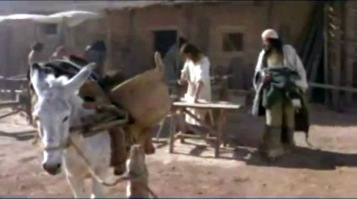
I was pleased to see the scene from John 7:1-9 in The Gospel of John (2005). It shows Jesus working at carpentry after his ministry began. The images to the right offer a visualization of the setting of Jesus’ life. For example, Jesus probably worked at carpentry outdoors rather than in an enclosed shop.

Though teaching was Jesus’ primary vocation, it was natural for him to continue his trade. In fact, “Rabbis were expected to gain a skilled trade apart from their study (thus Paul was a leather-worker), so that the stratification that divided teacher from manual laborer in Stoic and other circles of the Hellenistic world was not a significant factor in much of Palestine.”** We are not surprised to read about Paul working as a tent-maker at various times, so why not apply that same logic to Jesus’ experience?

* Justin Martyr, Dialogue with Trypho, chapter 88, trans. by Philip Schaff. The rest of the quote states, “making plows and yokes; by which He taught the symbols of righteousness and an active life; but then the Holy Ghost…descended on Him…” Justin sees a contrast in Jesus’ activity (“but then”) when his teaching ministry began, so our question to decide is how much contrast?

** D.A. Carson and Douglas J. Moo, Introduction to the New Testament (Grand Rapids: Zondervan, 2005), 240.

No responses yet

While teaching in the Synagogue at Capernaum

May 08 2020

John 6:59

Walking on water.

Not Sabbath eve.

Yet, in John’s re-telling, it is easy to assume two things. One, it is the next day, and two, that Jesus is teaching on the Sabbath.

No responses yet

Send in the Crowds

May 07 2020

Have you ever been part of a big crowd?

To your right, you greet local people who traveled across town. To your left, you meet people who traveled across country. Radio, tv, billboards, Web sites, and word-of-mouth are ways the crowd heard about the event.

Big crowds don’t just happen. They are part of a larger social context and communication network.

In Jesus’ story, we read about three big crowds. On one occassion over 5,000 joined Jesus. Later 4,000 gathered to hear him teach. A third account mentions a crowd of many thousands around Jesus (including hecklers).

Drawing a crowd of thousands today requires alot of time and effort including marketing plans, traffic logistics, auditorium setup, sound systems, security, etc.

Minus the technology, similar crowd-factors would apply in Jesus’ day.

  • Since crowds take time to gather, Jesus’ must have stayed put for a time
    rather than always being on the move.
  • Some marketing-like communication must have let people know where Jesus was.
  • A location with great acoustics and low background noise was critical since there was no amplified sound.
  • Regional population density and seasonal work demands impacted who could gather and when.

Understanding the nature of crowd-gathering reigns in our assumptions. We need to consider these factors as we read about crowds gathering to Jesus.

No responses yet

Pricked by my starting point

May 05 2020

You have heard the phrase, “I can do all things through Christ.” There’s a song, a poster, t-shirts, etc. It’s an inspiring tagline.

Here’s what I thought when I heard the phrase. If Christ can do all things for me, then he could do all things for himself, too. I assumed that Jesus’ experience was not subject to suspense or uncertainty. He never got into a jam.

Logically, I then wondered why I had so much anxiety and gridlock in my life if Christ could just bail me out like he did himself.

Either something was wrong with me or something was wrong with him.

I took a second look at the context of that phrase and was shocked by what I found.

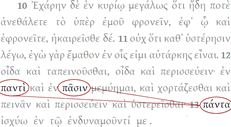
What I understand now, I will try to explain with a picture of the phrase from the original Greek. The circled words below mean “all,” so there are three references to “all” in the context of the “can do” phrase.  When it says, “I can do all things,” the “all things” summarizes the preceding the sentence, which includes

  • greek_phil4living in humble circumstances
  • times of surplus resources
  • having plenty of food
  • going hungry
  • times of surplus (repeated)
  • going without

It’s easy to see Jesus’ experience without any friction, like he was just acting out a movie script that he had already read. Sure, he put in a fine performance, but where’s the suspense? Anybody can go hungry one day when they know there’s going to be a fine meal the next.


No responses yet

The Galilee Kingdom Tour

Apr 30 2020

Jesus commissioned six disciple-pairs, twelve men, to take his message to the towns of Galilee. The Gospels of Matthew, Mark, and Luke provide background.

Matthew gives the scope of the operation. Jesus sent the twelve specifically to Israelite towns in Galilee, not to the foreigners of the north or the Samaritans to the south (Mt 10:5-6).

The basic message Jesus gave his men to speak: “The kingdom of heaven is near” (Mt 10:7). Jesus also instructed them to heal the sick, raise the dead, cleanse lepers, drive out demons, and freely give.

Mark and Luke offer Jesus’ instruction on the logistics of the speaking tour: “Take nothing for the journey” (Mk 6:8; Lk 9:3). So the twelve would be entirely dependent on hospitality.

So without any luggage, the twelve were heading into Galilee, a province that was 50 miles long and 25 miles wide. The mountainous region of Galilee extended from the Lebanese mountains in the north to the Jezreel Plain between Galilee and Samaria in the south, and from Lake Galilee on the east to just inland from the coast. (Tyre controlled the coast.)

Josephus commented that Galilee included over 200 cities and villages (Life, 235). Concerning the economy, Josephus writes, “Their soil is universally rich and fruitful, and full of the plantations of trees of all sorts. . . [the land] is all cultivated by its inhabitants, and no part of it lies idle. Moreover, the cities lie here very thick” (Jewish War, 3.43).**

Six teams to cover a populated region about the size of Rhode Island.

** Flavius Josephus and William Whiston, The Works of Josephus: Complete and Unabridged (Peabody: Hendrickson, 1987).

No responses yet

Cultural Sources behind the SpendaYearwithJesus Experience

Apr 28 2020

The Gospels serve as primary sources for the SpendaYearwithJesus experience. They Gospels provide numerous details of setting, characters, time, and action from which to build a framework around Jesus’ experience in his culture.

When considering legal and temple practice, E. P. Sanders offered a rule of thumb that includes 5 sources:**

  • the priestly writer [Leviticus],
  • Jospehus,
  • the Mishnah,
  • Philo,
  • Others such as the Dead Sea Scrolls, late Biblical books like the Chronicles or Nehemiah, Pseudepigrapha, and Apocrypha.

For Sanders, Leviticus, Josephus, and the Mishnah together are a solid witness to first-century legal-religious practices. Josephus and the Mishnah together are also probable while also ranking as probable is agreement between the Dead Sea Scrolls and Mishnah.

Three witnesses are best, however. In addition, with all of the sources, one must be aware of potential dependence of the later texts quoting or deriving from Leviticus.

** E. P. Sanders, “Comparing Judaism and Christianity: An Academic Autobiography,” 2004. A paper read at “New Views of First-Century Jewish and Christian Self-Definition: An International Conference in honor of E. P. Sanders.” Pages 21-22.

No responses yet

« Newer - Older »